 StAI Flow
Training 21 of 30
Pool and spa guest safety
Hospitality Safety Training · 21 of 30
Pool and spa guest safety
10 minutes

Section 1 of 4Understand the risk
You bring pool towels: the gate is wedged open and the deep-end bottom is hidden. Would you let children enter? Aquatics, guest services, housekeeping, engineering, and security recognize hazards. Qualified roles authorize operation or reopening.
104°F / 40°CMaximum recommended hot-tub water temperature
CDC guidance says hot-tub water should not exceed 104°F (40°C). This is not a swimming-pool target or proof of safe operation; qualified staff must verify applicable local limits and other controls.
Section 2 of 4Notice warning signs
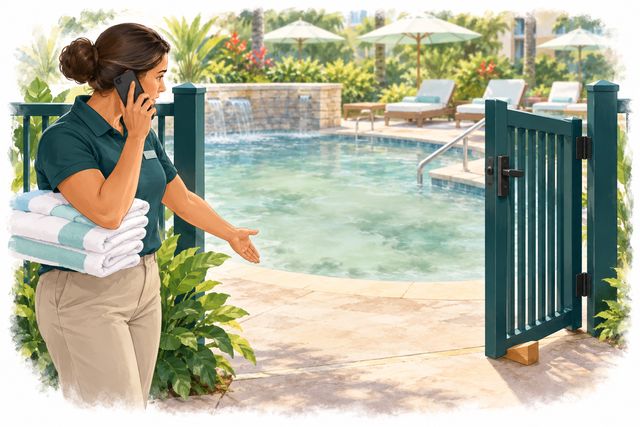
Unsecured gates or doors allow unnoticed child access. Cloudy water can hide people; missing or damaged drain covers threaten entrapment. Wet decks, glass, running, unsafe diving, crowds and contamination can cause injury or illness.
Federal law requires compliant anti-entrapment drain covers at public pools and spas; extra protection may be required. State and local codes govern staffing, testing, closure and signs. CDC’s model code is guidance unless adopted.
Appearance never proves safe chemistry; qualified tests and operating controls determine compliance.
Section 3 of 4Choose a safer next step
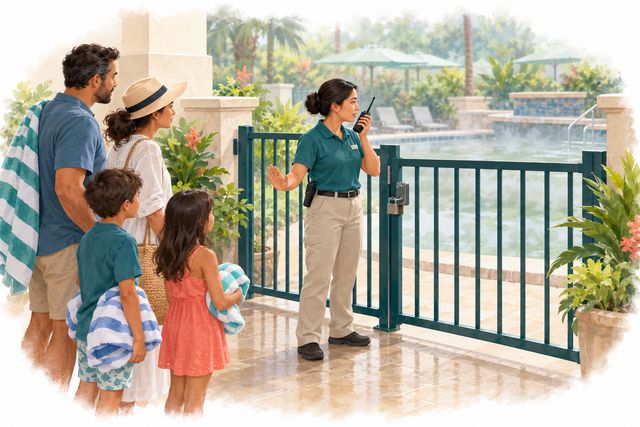
- Keep guests from suspected unsafe conditions; summon the qualified operator and use local closure and reopening procedures.
- Report barriers, visibility, drains, temperature, equipment, or contamination; reinforce supervision and rules without distracting lifeguards.
- For distress, activate the plan, alert lifeguard, assign 911 caller, clear responder access; assist only within training.
Safety boundary: This activity grants no lifeguarding authority, water entry, entrapment rescue, chemical adjustment or reopening of a closed pool or spa.
Section 4 of 4Practice the decision

Scenario: Delivering towels, you cannot see the deep-end bottom and find a gate wedged open. A parent asks whether children can enter while you find the operator.
Practice activity (4 min)
- Think 30 secIdentify the risk.
- Discuss 90 secAgree a safer plan.
- Compare 1 minCheck your plan below.
- Commit 1 minChoose your next-shift action.
Learner check
Based on the scenario above, what is the safest plan? Tap to reveal the answer.
Hold access, explain the safety concern, contact the qualified operator, and maintain restriction until authorized clearance. For distress, immediately activate trained aquatic help and 911.
Sources
Bonus resources
Free outside material to go deeper. These open on the publisher's site.
- Pool SafelyU.S. Consumer Product Safety Commission · Web page (free tips, posters, videos)
- Preventing DrowningCDC · Web page
- Water SafetyAmerican Red Cross · Web page (tips)