 StAI Flow
Training 17 of 30
Medical emergencies
Hospitality Safety Training · 17 of 30
Medical emergencies
10 minutes

Section 1 of 4Understand the risk
A breakfast guest suddenly slurs words and one arm looks weak. Would you wait for management? All departments may need to summon emergency help and provide a precise property-location handoff.
40 secondsA stroke occurs this often nationally
CDC’s October 2024 summary reports a U.S. stroke every 40 seconds. This population estimate cannot predict hotel incidents. Possible stroke symptoms need immediate 911 activation, even if they resolve.
Before my next shift, I will review emergency contacts and locate first-aid supplies and any AED.
Section 2 of 4Notice warning signs

Chest discomfort, breathlessness, faintness or unusual weakness can be urgent even if someone can talk. Sudden speech, face, arm, balance or vision changes may mean stroke. Unresponsiveness, abnormal breathing, severe bleeding, unsafe scenes or blocked responder access need prompt attention.
Federal requirement: Medical advice must be available and first-aid supplies readily available; trained first-aiders are required if treatment facilities are not nearby.
CDC: Possible heart attack or stroke needs immediate 911. Describe observations; do not await diagnosis or a supervisor.
Section 3 of 4Choose a safer next step
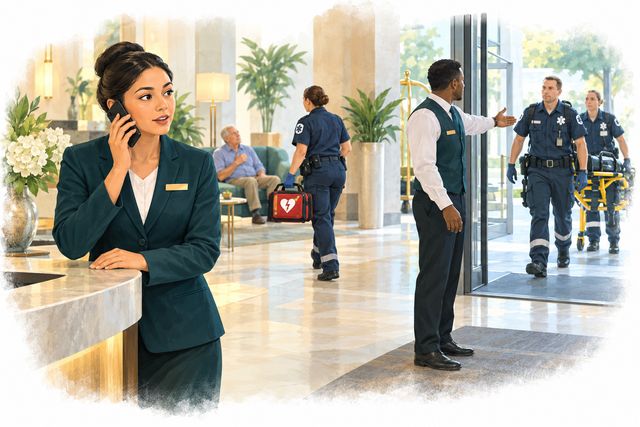
- Stay out of smoke, electrical danger and chemical atmospheres. Avoid unnecessary movement of an injured person.
- Call 911 and activate the site response. Give the property address, building, floor, room and observed symptoms. Note known onset.
- Name helpers to alert trained responders, obtain an available AED and meet EMS. Follow dispatcher guidance within your capabilities.
Safety boundary: During this activity, make no live calls, give no medicines, activate no alarms and do not practice on people. Never enter danger. Lifesaving care needs training or dispatch guidance.
Section 4 of 4Practice the decision

Scenario: At breakfast, a guest develops slurred speech and one weak arm. A coworker suggests waiting for the manager. How will staff summon help now?
Practice activity (4 min)
- Think 30 secIdentify the risk.
- Discuss 90 secAgree a safer plan.
- Compare 1 minCheck your plan below.
- Commit 1 minChoose your next-shift action.
Learner check
Based on the scenario above, what is the safest plan? Tap to reveal the answer.
Call 911 immediately and activate the site response. Report the exact location, observed symptoms and known onset. Arrange safe EMS access without waiting for management.
Sources
Bonus resources
Free outside material to go deeper. These open on the publisher's site.
- Hands-Only CPRAmerican Heart Association · Short video + web page
- Red Cross First Aid app (and other free apps)American Red Cross · Free mobile app