 StAI Flow
Training 15 of 30
Fire prevention and extinguisher decisions
Hospitality Safety Training · 15 of 30
Fire prevention and extinguisher decisions
10 minutes

Section 1 of 4Understand the risk
You know PASS, but smoke threatens your escape. Would you use the extinguisher? All departments prevent fires and need to know the property’s evacuation or trained-user roles.
1 yearEducation and designated-user training at least annually
Where extinguishers are provided for employee use, OSHA requires education initially and at least annually. Designated firefighting-equipment users need training on assignment and at least annually. Site policies and exemptions determine roles.
Section 2 of 4Notice warning signs

Combustible packaging near heat or uncorrected grease buildup can start or feed a fire. Blocked exits or extinguisher access can delay a safe response. Smoke, spreading heat, unknown burning material or the wrong extinguisher can make an attempt unsafe.
Federal requirement: Extinguishers must be readily accessible without exposing staff to injury. Their presence does not assign employees a firefighting role.
Site policy: Only trained, authorized users may consider a small contained fire with the correct extinguisher, clear escape and safe conditions.
Section 3 of 4Choose a safer next step
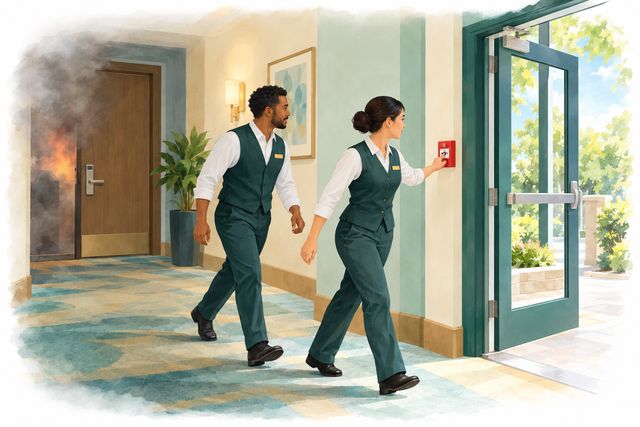
- Keep combustibles away from heat. Report damaged heating equipment and missed cleaning. Leave specialist servicing to assigned personnel.
- Report the fire through the site plan from safety. Avoid delaying evacuation to find a supervisor or belongings.
- Evacuate when safe-use conditions are missing or worsen. Never put water on burning oil. Class K and suppression require training.
Safety boundary: During this activity: No flames, smoke, pin pulling, extinguisher discharge, suppression activation or live alarm tests. It grants no extinguisher-use authorization.
Section 4 of 4Practice the decision

Scenario: A cooking-area fire is small, but smoke crosses the escape route. A worker knows PASS without site training. What is the safe decision?
Practice activity (4 min)
- Think 30 secIdentify the risk.
- Discuss 90 secAgree a safer plan.
- Compare 1 minCheck your plan below.
- Commit 1 minChoose your next-shift action.
Learner check
Based on the scenario above, what is the safest plan? Tap to reveal the answer.
Evacuate and raise or report the alarm under the site plan. Knowing PASS does not supply qualification, and a smoke-threatened escape route rules out an attempt.
Sources
Bonus resources
Free outside material to go deeper. These open on the publisher's site.
- Choosing and Using Fire ExtinguishersU.S. Fire Administration (FEMA) · Web page (PASS steps)